Which dart barrel is right for me? Complete buying guide for 2026
11-05-2026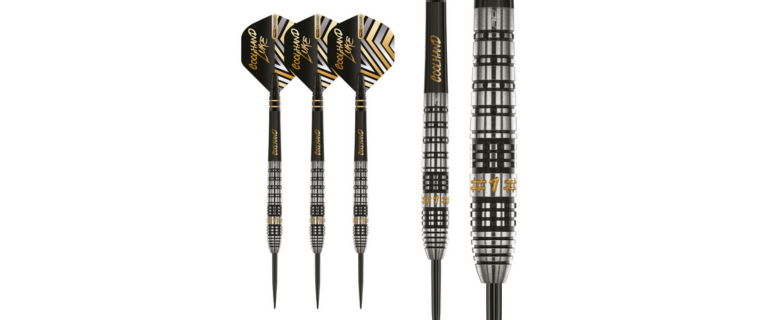

Short answer: Beginner players are best served by a straight barrel of 22 to 24 grams in 90% tungsten with a medium grip. This weight and shape are used by the majority of PDC professionals and offer the best balance between control, consistency and manoeuvrability. Popular entry-level steel tip darts in this category are the KOTO Sting Black Straight 90% and the Winmau Tuscan.
The barrel is the central, weighted part of a dart and has the biggest influence on how the dart feels in your hand and how it flies. Weight, shape, material and grip together determine whether a dart suits your throwing style.
This guide explains each component separately, gives concrete recommendations per skill level, and ends with an FAQ covering the most common questions about dart barrels.
What is a dart barrel?
The dart barrel is the metal central section of a dart, between the point and the shaft. The barrel contains virtually all the weight of the dart and is the part you grip with your fingers. Shape, weight, material and grip pattern of the barrel determine 90% of the playing experience.
Which dart barrel weight is best for me?
For steel tip darts the optimal barrel weight is between 22 and 26 grams. For soft tip darts (electronic dartboard) the maximum is 20 grams. Unsure? Start with 24 grams — this is the most commonly used weight by both beginners and professionals.
• Light darts (18-21 grams): Require a faster, more forceful throw and are ideal for players with a quick release.
• Medium-weight darts (22-25 grams): The best choice for the majority of players. Stable, consistent and suitable for almost any throwing style.
• Heavy darts (26 grams and up): For players with a soft, controlled throw. Maximum stability, but require more deliberate aim.
World champion Luke Humphries throws with 23 grams, Michael van Gerwen with 22 grams, Luke Littler with 23 grams. The idea that all pros throw heavy is incorrect — the average pro weight sits around 22-24 grams.
What barrel shapes exist and which suits my throw?
There are five main shapes for dart barrels. The shape determines where the weight sits and how the dart feels in your hand.
• Straight barrel: Weight is evenly distributed. Suitable for nearly anyone, ideal for beginners. Michael van Gerwen, Gary Anderson and Luke Humphries all use straight barrels.
• Torpedo / bomb barrel: Shorter and thicker at the front. Good for players with a fast throw and tight grouping. Phil Taylor played with a torpedo.
• Scalloped barrel: Features deep ring grooves for maximum grip. Ideal if your darts slip out of your hand or you have moist fingers.
• Tapered barrel: Slim tapering towards the point. Improved aerodynamics and tight grouping, mainly for advanced players.
• Teardrop barrel: Teardrop shape with the weight in the centre. Requires precise grip technique and is less suitable for beginners.
What is the difference between 80%, 90% and 97% tungsten darts?
The tungsten percentage indicates how much tungsten is processed into the barrel. The higher the percentage, the slimmer the barrel at the same weight, allowing you to group tighter on the dartboard.
• 80% tungsten: Affordable entry-level quality. Slightly thicker barrels, fine for beginners still discovering their preference.
• 90% tungsten: The standard for most players. Slim, stable and durable. This is the most sold type.
• 95-97% tungsten: The slimmest barrels possible. Maximum precision and grouping, used by many PDC professionals.
Brass darts are cheaper but much thicker at the same weight. For recreational pub use they are fine, but for serious practice tungsten darts are nearly always the better choice.
What grip do I need on my dart barrel?
The grip is the surface pattern of the barrel. Which grip suits you depends on how dry or moist your fingers are when throwing.
• Smooth: Few or no grooves. Suitable for players with dry fingers and a fast, smooth release.
• Medium grip: Light grooves or rings. The most chosen option and suitable for most players.
• Aggressive / shark grip: Deep rings, cross-hatching or shark fins. For players with sweaty fingers or a slower throw who want more control.
Tip: pick up a dart and hold it in front of your face for 2 seconds. Does it slip out? Choose a more aggressive grip. Does it stick? Go for a smoother pattern.
How long should the barrel be?
Barrel length depends on your grip — specifically how many fingers you place on the barrel. Average length is 50 mm, but the range runs from 35 mm (short) to 55+ mm (long).
• Using 2 fingers (thumb + index): choose a short barrel of 35-45 mm.
• Using 3 fingers: choose a medium barrel of 45-50 mm.
• Using 4 fingers or placing your fingers far back: choose a long barrel of 50-55+ mm.
Which dart barrel do we recommend per skill level?
For beginners (first set)
Choose 22-24 grams, straight barrel, 90% tungsten, medium grip. A good entry set is the KOTO Sting Black Straight 90% (straight barrel with a comfortable ring grip, available in 17 weights from 10 to 32 grams).
For intermediate players
Experiment with 22-25 grams in 90% tungsten and choose a specific shape and grip that suits your throwing style. The Target Bolide Void 01 90% is a strong choice in this category: a straight barrel with sandblast radial grooves for extra grip, black titanium coating, and Target's Swiss Point system allowing you to swap points in seconds without tools.
For professionals and serious players
Go for 95% tungsten with a shape and grip that exactly matches your technique. The Target Nathan Aspinall G2 Swiss Point 95% is a good example: a 95% tungsten barrel developed with the 2023 World Matchplay Champion, with multiple grip profiles in one barrel (CNC-milled cross-sections at the front, radial grooves at the back), red PVD coating for extra grip and the Swiss Point system for interchangeable points.
related blogs
Best beginner darts in 2026
How do I choose the right dart shafts?

How do you get better at darts?